Piaget, Bruner, and Vygotzky

Piaget:
Piaget was a
biologist who lived from 1896-1934. In that rather short life, he contributed
much to our understanding of how children learn. His first profession was that
of a biologist. As with most scientist, he had a keen sense of observation and
insightful way of questioning what he saw. Children’s thought processes
fascinated him and he wanted to know how they ticked. He developed his thoughts
around the idea that children first learn in very general terms and then build more
complicated schemes. Schemes are how information is organized. For instance, a
may have a scheme that says all fuzzy animals with a tail are dogs. Later
through a process of disequilibrium, a child learns that not all fuzzy critters
are dogs. An accommodation has to be made that includes different schemes for
cats and dogs.
Bruner:
 (Image Source: http://www.scottlondon.com/images/covers/bruner.jpg )
Word template for authors, EIAS Style B
Vygostsky:
 (Image source: http://0.tqn.com/d/psychology/1/0/W/9/lev-vygotsky.jpg )
Word template for authors, EIAS Style B
Bruner:
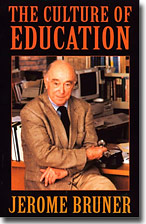
Jerome Bruner was
born in 1915 and is still on faculty at NYU. He believed much like Piaget in
that everyone tried to categorize everything so that they can make sense of it.
They did this through three different ‘modes’: enactive where learning is through the act of doing, iconic
where learning is through visually making sense symbols such as the written
word and finally there is symbolic where learning is through reasoning, logic
and abstract thinking. A wonderful thing about his theory is it states that the
learner actively builds their knowledge through social construction. This
process can be helped along through a questioning method referred to the
Socratic Method. He also advocated what is called spiraling, revisiting curriculum
in more and more complex terms.
Vygostsky:


No comments:
Post a Comment