That is me- on the left. My family and a couple friends drove for 24 hours to Siesta Key in Florida. My daughter is jumping full force straight into the waves.
I am in the Urban Teaching Program at Metropolitan State University. My license area will be Language Arts. I originally started off as a Math Major but switched out when I got to Calculus II. I realized it was keeping me from doing what I truly love- Language Arts. I regret nothing though. Along the way, I learned so much I otherwise would not have.
I firmly believe that each child has a spark of wonder that can drive their learning. My goal is to help develop that sense of awe in the world as they critically think about how they will define their future. I want for each child to see a future full of possibilities, have the skills to grab hold of them and throw themselves at their dreams just like my daughter jumping for the wave.
Definitely count me in the constructivist camp. Children even when
they are born do not come to us as blank slates. They have personalities
and preferences already built into who they are. This will help shape
how they approach the world and learn from all those around them. It
will be important to remember that students have a base knowledge before
they start school and then as they go through school and life they
build on it. I believe children learn best when actively engaged with
more than their minds- their whole being needs to be piqued to the
learning experience so they can understand it, whatever 'it' is, on a
more complete level. As such, it is a teacher's job to guide learning
and helping the student make sense of the content. It is not enough for
students to spit out the same input they heard or read. True learning is
incorporating new ideas into old one, forming deeper meaning, being
able to share that new perspective and then synthesize that new
understanding with other people- and with technology there are now so
many new and wonderful ways to interact with other people!
As stated in a previous post, my content area is language arts. I
learned to read and write by reading and writing- haha. I have found
these to be something I get better at just by doing them and challenging
myself to read and write more with more complexity. Also as previously
posted, I never did become a good speller. That is one area that has not
improved. I like to say if the nuns couldn’t beat an ability to spell
in me, nothing would. Somehow I muddle on by. That not withstanding, I
did have fantastic teachers all along the way who helped with feedback
and pointing me to some very good literature. They pushed me to be more
comfortable with public speaking too- handy for standing in front of a
classroom. I was given the chance to fail and then fail better next
time. Over time my writing and reading skills improved as I found my
voice and could critically think about other people’s voices.
Code of
Ethicsfor Minnesota Teachers Standards of Professional
Conduct
A
teacher shall provide professional educational services in a
nondiscriminatory manner.
A
teacher shall make reasonable effort to protect the student from
conditions harmful to health and safety.
In
accordance with state and federal laws, a teacher shall disclose
confidential information about individuals only when a compelling
professional purpose is served or when required by law.
A
teacher shall take reasonable disciplinary action in exercising the
authority to provide an atmosphere conducive to learning.
A
teacher shall not use professional relationships with students, parents,
and colleagues to private advantage.
A
teacher shall delegate authority for teaching responsibilities only to
licensed personnel.
A
teacher shall not deliberately suppress or distort subject matter.
A
teacher shall not knowingly falsify or misrepresent records or facts
relating to that teacher's own qualifications or to other teachers'
qualifications.
A
teacher shall not knowingly make false or malicious statements about
students or colleagues.
A
teacher shall accept a contract for a teaching position that requires
licensing only if properly or provisionally licensed for that position.
When I was going
up, I went to this place called a library when I had to do research for a
paper. They were and still continue to be places with great stores of
knowledge. I lucked out and had one three blocks from my house. Hours I spent
plowing through books. In my mind, the internet and electronic databases act as
modern day libraries… with of course some key differences.
The default to
get information has become how to access it via the internet. The internet also
acts as means to share personal thoughts and ideas, some with more credibility
than others. So as students learn to tool around the internet, it will be
important to teach them how to look with a critical eye towards validity of
sources. This is a skill that can be taught in my content area of language
arts- looking for the biases, comparing multiple sources and synthesizing
towards something that approaches the truth.
Students can
also create their own depositories of knowledge and understanding. As part of
reading a book, The Croquette for example, they can examine primary source
documents found online in databases and other webpages. They can then create
new layers of appreciation by building mock Facebook pages for character and
then interacting as if the character from the book. Reading and writing skills
are enhanced. Engagement can increase because they took it from consumption of
information to creating their own twist of it. For as long as it has some bases
in reality and context from the book, what’s not to love? Students can also use
databases and the internet to directly connect more easily with the creators of
information through email, messaging, chat rooms, Skype or their equivalent on
different platforms.
I also want to
point that the digital divide helps lead to other divides in this country-
education, employment, socioeconomic status, health amoung many others.
Whenever possible, those involved in education especially within urban schools
need to take steps to close the gap. Incorporating explicitly on how to
navigate, use and harness for their own voice over the internet should be part
of lessons in language arts as well as other content areas. Students need to be directly taught the
critical thinking skills they will need in the future and practice using them
within the educational system. It is not good enough for them to only be
consumers of whatever mush is being served on the internet and various
databases. The so called Information Age means nothing unless coupled to The
Age of Understanding.
For a behaviorist, assessing learning would
involve requiring students to reproduce facts and concepts as they were given
to them. There is a huge drill and (s)kill mentality to this perspective. Learning
is also organized in a very linear fashion and students would be discouraged
from moving on until they master those concepts. Mistakes must be fixed
straight away so that the child does not form a bad habit. Perhaps the most
discouraging idea to this idea of learning and assessing of learning is how
much emphasis there is on motivation coming from outside forces. Overall, I am
quite pleased this is not a very popular theory of learning anymore.
Cognitive psychologist look at learning and
assessing quite differently. Children are viewed as active learners with power
to build their own knowledge base. It is understood that children and learners
will often times categorize the world in very broad terms and then as they
learn more see more discrete pieces and differences. They believe children to
need more of a guide to help them by asking questions and then letting them
learn by self discovery. Motivation to learn comes from being confused but then
gaining new understanding. In this theory, I would argue that assessment is
more about tracking progress, letting the learners also self evaluate and from
there gauging how to proceeded.
Piaget was a
biologist who lived from 1896-1934. In that rather short life, he contributed
much to our understanding of how children learn. His first profession was that
of a biologist. As with most scientist, he had a keen sense of observation and
insightful way of questioning what he saw. Children’s thought processes
fascinated him and he wanted to know how they ticked. He developed his thoughts
around the idea that children first learn in very general terms and then build more
complicated schemes. Schemes are how information is organized. For instance, a
may have a scheme that says all fuzzy animals with a tail are dogs. Later
through a process of disequilibrium, a child learns that not all fuzzy critters
are dogs. An accommodation has to be made that includes different schemes for
cats and dogs. Piaget also
theorized children went through predictable stages of development.
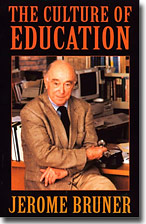
Bruner:
(Image Source: http://www.scottlondon.com/images/covers/bruner.jpg ) Word template for authors, EIAS Style B
Jerome Bruner was
born in 1915 and is still on faculty at NYU. He believed much like Piaget in
that everyone tried to categorize everything so that they can make sense of it.
They did this through three different ‘modes’: enactive where learning is through the act of doing, iconic
where learning is through visually making sense symbols such as the written
word and finally there is symbolic where learning is through reasoning, logic
and abstract thinking. A wonderful thing about his theory is it states that the
learner actively builds their knowledge through social construction. This
process can be helped along through a questioning method referred to the
Socratic Method. He also advocated what is called spiraling, revisiting curriculum
in more and more complex terms.
Vygostsky:
(Image source: http://0.tqn.com/d/psychology/1/0/W/9/lev-vygotsky.jpg ) Word template for authors, EIAS Style B
Lev Vygotsky lived from
1896-1934. One of his central ideas was that of ‘the zone of proximal
development’. It states that each person has a certain potential to their
ability to learn that can be greatly affected by cultural and social
connections. He said that even though learning should be directed by someone
with a certain level of expertise, it is not limited to only that arena.
Learning can take place from peers and other people. In fact, learning can also
be reinforced when a learner helps another peer.
As described in
the technology standards, spreadsheets are another way to increase student
learning, improve efficiency, access different types of learners and provide
multiple ways to assess student work. I’ve fallen in love with Google Docs as
an easy and free way (ha, minus how they collect your data and advertise to
individuals but that aside...) for students to use spreadsheets and other
programs for word processing. Teachers can also use spreadsheets as a way to collect information traditionally kept in a grade book. Unlike the standard Microsoft Suite, using spread
sheets in Google Docs can be collaborative and a breeze for the teacher to
track.
Because it is
such an open-ended tool, spreadsheets can be used across all content areas.
They can be used in the Language Arts field to make reading logs. For as long
as the student has the needed info, it can look the way they want it to look.
This can make reading logs more empowering since they designed the layout.
Spread sheets can also be used to organize information when reading. For
instance, it might make more sense to use a spread sheet to compare and contrast
text. Similarities and differences can be easily seen as the eyes scan the
columns. Based on student preference, spread sheets can also be a more visual
way to sort important pieces of information from stories, arguments and
speeches they are examining in class. Overall, this is a technology tool that
can expand learning and student engagement if they are taught all the wonders
found in the program.This grade and other progress can then often times be uploaded to online grade books often provided by school districts.
Podcasting is a wonderful two way street that students can use to get
information and create projects as well. Basically a podcast is usually an
audio file but sometimes also an audio/video file that students can download
from various sources. They then can play that file on many devices such as an
iPod/Pad/Phone or any device that allows mp3/4. Teachers can research podcasts
that align with the standards and enrich lessons from the classroom. If
students are studying great speeches, many have been translated to audio files
and can be listened to via the internet or other device.
Many podcast are free and come from topnotch institutions such as
universities and non-profit organizations. There is a vast assortment of
podcast available that run the gambit MIT Open Courseware, foreign language
learning, lectures of all kinds and basically anything someone can think of… or
if no one thought of making a podcast of it, great idea for a student to do it.
The Apple Store has many free podcasts and even ones that include audio as well
as video. NPR also has an extensive database of podcast as well. I have not
been able to yet, but I would like to spend time searching out the best podcast
by others their own age too.
Another use for podcast is as a tool for students to use to share
information and projects they created. The equipment needed is minimum and
often times quite cheap. For students who struggle to write, this can be
another format for them to use that demonstrates mastery of content. PBS did a
great series about students using technology that included some making podcast
for other students to use as part of a science museum field trip. Books can be
read to younger students. Family histories can be documented and shared as part
of a language arts unit using a podcast as a summative evaluation tool. For me,
I try to think of technology use in terms of from many to many. I like to think
of it as one more way to connect learning across a broad spectrum.
No offense, but I can't quite wrap my brain around this even being an
issue. I'm open to hearing how evil word processors are but doubtful it
can be well argued their value in education.
Word processors have made creative creation a much easy task. I
remember it being A Big Deal to have to do revisions when I was in grade
school. And why? It meant laboriously handwriting the whole thing all
over. Talk about a barrier where only the most enthusiastic writers
would embrace the process of making their paper their best it could be. I
am of the transition generation between paper and pencil to keyboard
and screen. There was that lovely pit stop involving a type writer. I
thought it fantastic to not worry about penmanship. Plus there was
something oddly soothing about the rhythmic sound. But alas with no edit
function, whole papers still had to be rewritten. So score one for ease
of editing in word processors.
Another improvement is being able to emphasize art in the whole
language arts content area. Word processors allow for all sorts of
personal freedom in terms of font, size, format, color and on and on. To
hit upon those aspects, one use to have to be an artist! Now it’s a
matter of dreaming and visualizing then matching that to tools found in
most word processors. It adds depth that can not easily be attained by
handwriting. So score two for unlocking self-expression in word
processors.
Finally, there are all the added benefits to having work done in a
word processor. You better believe I am typing this in Word and letting
it catch all my embaressing embarressing embarrassing spelling errors.
Word documents can be saved and shared with simplicity. I have fallen in
love with Google Docs for how collaborative a process group projects
can be without having to physically be in the same location. This is
also the way of the workplace for all the previously mentioned reasons.
Score three for word processors naturally scaffolding skills needed in
life and the workforce.
Students should leave school with the skills needed to put together
snazzy and impressive documents of various purposes. I love all the
content areas- math, science, social studies... but students need strong
skills in language arts to fully unlock the power of the other content
areas. Using word processors encourages growth in reading and writing
skills by making it easier to make those skills part of daily practice.
Next, think about the primary subject that you hope to teach. How did
you learn what you know in that subject area?
My content area is Language Arts. Back in the (my) day, this
referenced mainly writing and reading. Stressed topics included short
essays on various subjects, vocab and reading across many genres. One
thing I never quite mastered was spelling. The main ways I learned these
things was through direct instruction, feedback from papers and tests.
_____________________________________________________________________________
Next, identify concepts or ideas which you learned that are probably
no longer considered to be important to the student's classroom
curriculum today.
Spelling is getting to be a lost art. I don’t see vocab as heavily
emphasized either. When it comes to reading, I have seen a higher
expectation to go beyond simple comprehension to synthesizing that
information to the larger world.
_____________________________________________________________________________
Explain why you think those ideas are no longer important.
For spelling, I think the obvious answer is how easy it is use spell
check. Technology also makes it easy to look up definitions of words.
Reading for simple comprehension is not enough in today’s highly
connected world.
_____________________________________________________________________________
How are these concepts or ideas impacted by technology?
These all are greatly effected by technology. Children now need to be
savvy many kinds of literacy. No one can afford to be only a mindless
consumer of all that can read in all the forms that takes place. No one
can afford to only be able to respond to the world in one way. Writing
skills need to cover multiple areas where writing is required or done
for pleasure.
Here's my list of 10 websites and a brief description that might be useful as a language arts teachers:
Word template for authors, EIAS Style B
Half.com
1. Many college students use this site to buy textbooks for
their classes. This can also be a great place to buy books for (usually) much
cheaper than from a brick and mortar store. To find a book, simply enter the
book’s name or ISBN. The search engine will then scourer its affiliated sellers
looking for the book. A list will then display the various sellers and
condition of the book. Half.com is run by Ebay and has a ratings system for
sellers. With school budgets tight, using this site can help stretch the
funding a little further.
http://www.ncte.org/
2. This is the website for the National Council of Teachers
of English. Their stated mission is: "The
Council promotes the development of literacy, the use of language to construct
personal and public worlds and to achieve full participation in society,
through the learning and teaching of English and the related arts and sciences
of language.”
Tips of the trade can be found here. Many resources and ideas to inspire the
Language Arts teacher. This is the largest professional group for Language Arts
teachers and hosts various workshops.
http://freerice.com/#/english-vocabulary/1449
3. Kids (and anyone!) can play a multiple choice vocabulary
test. For each right answer, 10 grains of rice will be donated through the
World Food Programme. It’s a great way to build vocabulary and help donate food
to those in desperate need.
http://www.ordway.org/education/performances/
4. Get out of the classroom! Here’s a low cost way to have
students experience top quality performances at the Ordway. By following the
link, you find tickets for $3.50-$5.00 to weekday matinees. There is also a way
to request reimbursement for a bus so you don’t break the piggy bank on that
either. Do note that it is first
come, first dibs. Tickets can be bought as early as the summer before the
school year so plan ahead.
http://education.state.mn.us/mde/index.html
5. Here’s the Department of Education’s official website. I
personally can not navigate it for nothing since they did an overall of the
site right after I had finally figured it out. None the less, it is a must for
staying on top of content standards, testing stats and other useful information
related to being a teacher, parent and student.
6. Inspire students with the greatest 100 speeches of all
time. Each speech on this list as the name of the person giving the speech,
title, audio if available, video if available and pdf. This could also be a
site to analyze for biases based on who was and was not included. Overall a
nice resource.
http://www.khanacademy.org/
7. I can not resist adding this to my webpage resources even
though most of it has to do with math. I feel it is justified because now there
are numerous links related to the humanities that can prove to be a fertile
ground for researching topics that might come up in class. All the videos are
free, usually no more than minutes and delivered in a way that usually makes
sense while maintaining complexity of the topic.
http://www.eslcafe.com/
8. This is a website that focuses on English language
learners. Much of the site is related to teaching English overseas but there is
nothing to stop you from using it right here. The “Stuff for Teachers” tab is
particularly amazing due to the number of ideas and links within it. I also
like the list of idioms/slang under the student tab. You can forget how many
there are and how confusing they can be to learners not native to the language.
http://www.readwritethink.org/
9. In one word: Overwhelming! I get lost with all the
fantastic resources available at this website. There’s no shortage of lesson
plans and ideas for the classroom. They can be searched by grade or topic. In
addition to that, many great graphic organizers can be found at this link. Top
quality material!
http://www.onlinenewspapers.com/
10. Last but not least is this website that links to 1000s
of newspapers around the world. It is organized by area and then country. The
reason I include this link is because of how powerful it can be to read news
sources that came from other perspectives. It can also be neat for students
from other countries to follow in their own first language news from their
roots. For anyone though, it can encourage more reading as they explore other
cultures and views.
2c's Worth: giving a personal opinion to one or more people (or do you mean the blog?)
Blogging:
also known as weblog, is an online tool used to communicate and interact
online.
Blogger: a person who maintains a blog and maintains control over content
thereof
Feed Burner: I can not sum it up very well. It is software to track and give
statistics about visitors to my blog.
Here's
a few blogs that I enjoy:
1.
http://www.khanacademy.org/about/blog
This
mainly focuses on math and science but it also starting to branch out into some
humanities. It started out as a way for the founder to tutor his niece across
many states distance. Pretty soon her friends were watching the videos and
requesting topics. There are now over 3000 videos that can be accessed for
free. Also included is a math practice area that takes students from basic
addition to linear algebra and everything in between. Seriously amazing
resource and this blog will keep you up to date on all the great things going
on! All ages J
I love Star
Wars and the creative visionary behind it is George Lucas. This is a blog
associated with Edutopia, his nonprofit that has a goal of encouraging and
celebrating innovation in education. The purpose of this blog is to bring
poetry alive in the classroom in a the digital age. It is a resource for ways
to attack poetry from all available multimedia elements. In doing so, students
are better able to speak truth to power and find their voices. Grades K-12.
3. http://www.wirededucator.com/blog/
I admit- when
it comes to the whole Mac v PC, I love me some Mac. It’s not just there
computers either. Everything they make makes me want to knock off the local
7-11 and take my ill got funds to the nearest Apple Store. Not that I would
ever actually do it! Although on the new side, it’s on my feed so new posts
will pop up. The owner has many great ideas and tips of the trade for using Mac
products in the classroom. He also points out that 1 in 3 students have an
iPhone and to let that power idly go wasted hiding in their pockets. There are
many ways to use and pair up technology so all can have access and knowledge.
This blog is worth a look. Mainly 6-12 but some also lower grades.
Run by a
language arts teacher who is working hard to meld all the possibilities of
technology in to educational possibilities for his students... and taking his
blog readers along for the read too. Mainly 6-12.
5. http://www.freetech4teachers.com/
Blog for
free lesson plans and ideas for using technology in the classroom. A serious
number of days would be needed to comb through this awesome blog! Grades K-12.
6. http://eduoptimists.blogspot.com/
This blog
takes a look at the policy side of education. It’s in depth and provides some
opinions as to the state of education in America. K-University.
7. http://www.storiesfromschool.org/
Tales from
the classroom by teachers. There’s the book learning side of education and then
there is controlled chaos theory in action. Many perspectives can be read and
learned from this blog. Grades K-12.
8. http://interactivelanguagearts.com/
Blog
specifically about using multi-media venues to the language arts classroom.
Grades K-12.
9. http://blog0rama.edublogs.org/
Long
running language arts teacher’s blog. Posts are nicely tagged and labeled so
they’re easy to search. Mainly for the high school level.
10. http://doctorgoodreader.edublogs.org/
This blog
has posts from an American teacher working in Ecuador. She designed a very
interesting method of helping students reach higher levels of reading
comprehension and writing complexity.
This blog is linked to my Weebly. Together they align the work from the class to teaching standards as set forth by the Minnesota Department of Education and show understanding of the teaching standards.